Kingsville passed it’s Affordable Housing Strategy at our February 25, 2019 meeting (at the very beginning of the present term of Council). This followed public consultation which included a round table and survey, the results of which were presented to council at the June 11, 2018 council meeting.
“The Town of Kingsville Affordable Housing Strategy is designed to provide a framework by which the development of affordable housing can be encouraged as part of both new development and integration into existing underutilized but fully serviced areas. It is a key goal and requirement for Kingsville to meet the housing needs of all residents, at all income levels and all stages of life. Access to safe affordable housing is an important part of the overall health and livability of the community.”
The outcome of the Affordable Housing Strategy has not resulted in affordable housing.
It is not working. We need to do better.
Too often, legislators and developers claim that prices will adjust when supply meets or exceeds demand. This is a simplistic economic view of this complex situation. And even if it did work that way, people that need housing cannot wait for the market to decide to make it attainable or affordable.
By allowing higher density builds without an affordablility component we are incentivizing changes to the character of our town without meeting the needs of the people who live here and need housing.
Developers are encouraged to buy single homes and turn them into profitable condos. This infilling and increase in density is recognized as an answer to affordability, but it is not nor has it been anywhere. We can look at housing prices in any condo dense city and find lack of affordability despite sharp increases of number of units (ie. Vancouver). Restricting development to only single detached homes will also keep home ownership out of reach for many.
There needs to be remedy through policy.
Perhaps our municipality needs an inclusionary zoning by-law. The province passed this legislation that would allow Ontario municipalities to REQUIRE affordable housing as part of new residential developments. It is up to us to implement this possibility into our policies, there needs to be political will to prioritize affordable and attainable housing.
It’s not just a Kingsville concern
On August 4, 2021 I attended a panel discussion called Ontarians On The Move. The panel included Mike Moffat of Smart Prosperity Institute, Lori Atkinson from Libro Credit Union, Eric Hill from Can Am Urban Native Homes, Ami Patel from Windsor Essex Community Housing, Huga Vega from YMCA and city council member, Rino Bortolin.
Here are some highlights from the panel:
~ Prior to covid, growth was not predicted or planned for and can be attributed to three factors: 1. Migration towards Ontario from both East and West; 2. Immigration to Ontario which is presently a more desirable province; 3. Non-permanent residents that often end up staying (such as international students).
~ 60,000 people left the GTA driven by young families seeking affordable housing.
~ We need both market housing and affordable housing to meet the current needs; more houses alone will not address the needs of those priced out of the market.
~ Green space needs a social license to exist; ON is losing 175 acres of green space every day!
~ Affordable housing is determined by housing that costs no more than 30% of income.
~ Affordable housing is NOT affordable to build; even for non-profits. Financial institutions will not loan money to builds considered affordable because 30% of the incomes of those in need of housing is not enough money.
~ Windsor Essex Community Housing is presently building its first affordable housing building in 40 years!
One thing that is clear – Affordable Housing is not a simple issue to solve and it will take efforts on behalf of all levels of government to make any real progress.
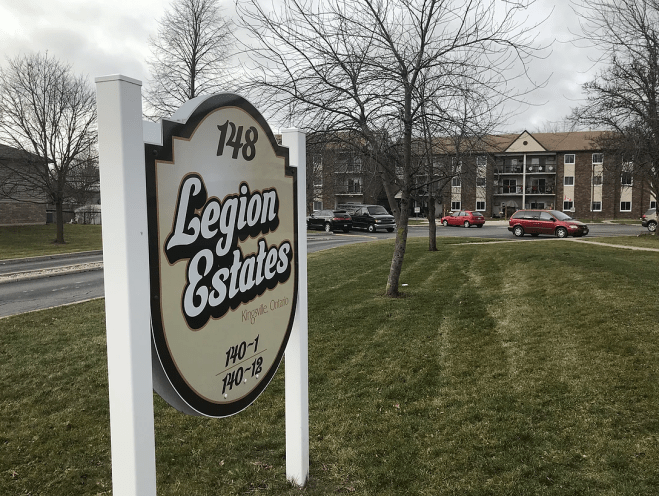
I’ve made it no secret that I support mixed market housing. You can read some comments I made on this topic in this Kingsville Observer article: Increased affordable housing, core residential development eyed in official plan revisions. Mixed market is housing that includes a mix of full market rents and subsidized rents. It provides a safe and desirable place for all and it prevents an area from turning into a dilapidated space. The Legion Estates are an excellent local example of mixed market housing. It has a wait-list for both full market and subsidized units. It is situated in a residential area predominately made up of single family dwellings, and yet this three storey building and surrounding townhouses do not stand out or change the character of the neighbourhood.
Secondary dwellings are another tool presently supported by the province. These were adopted in Kingsville with an Official Plan Amendment in December 2015. Added to Section 2.10 to the Official Plan which permits secondary dwelling units in all residential zones with access to full services. There has not been a lot of uptake in this option but there has been some resistance to accepting them. Concerns stem from the secondary dwellings changing the character of a neighbourhood. There is the perception that these units are duplexes and also that when they are added to the tops of detached garages they infringe on neighbour’s privacy, access to sun and more. We need to define this better, in my opinion, to allow the benefit of the units without harming existing neighbourhoods.
There is also the issue of rural property owners not being permitted to sever a lot for their family member. This restriction was in an attempt to preserve farm land. But in this current climate of housing prices and availability, it is not fair and makes no sense to prevent a rural property owner, with ample space, from providing a lot for their child.
The solution to affordable housing will not be found in a single action. The needs of the community are diverse and so should the response and remedy to the affordable housing issue.
I will be adding to this post as new information and opportunities arise.

